
The Man Who Reawakens Things
Richard Gerver spent twenty years teaching children they were more capable than the adults around them believed. He has spent the last twenty telling corporations the same thing. The punchline, which he delivers with considerable relish, is that the lesson has not changed at all.
Richard Gerver
·
June 2026
·
15 min read
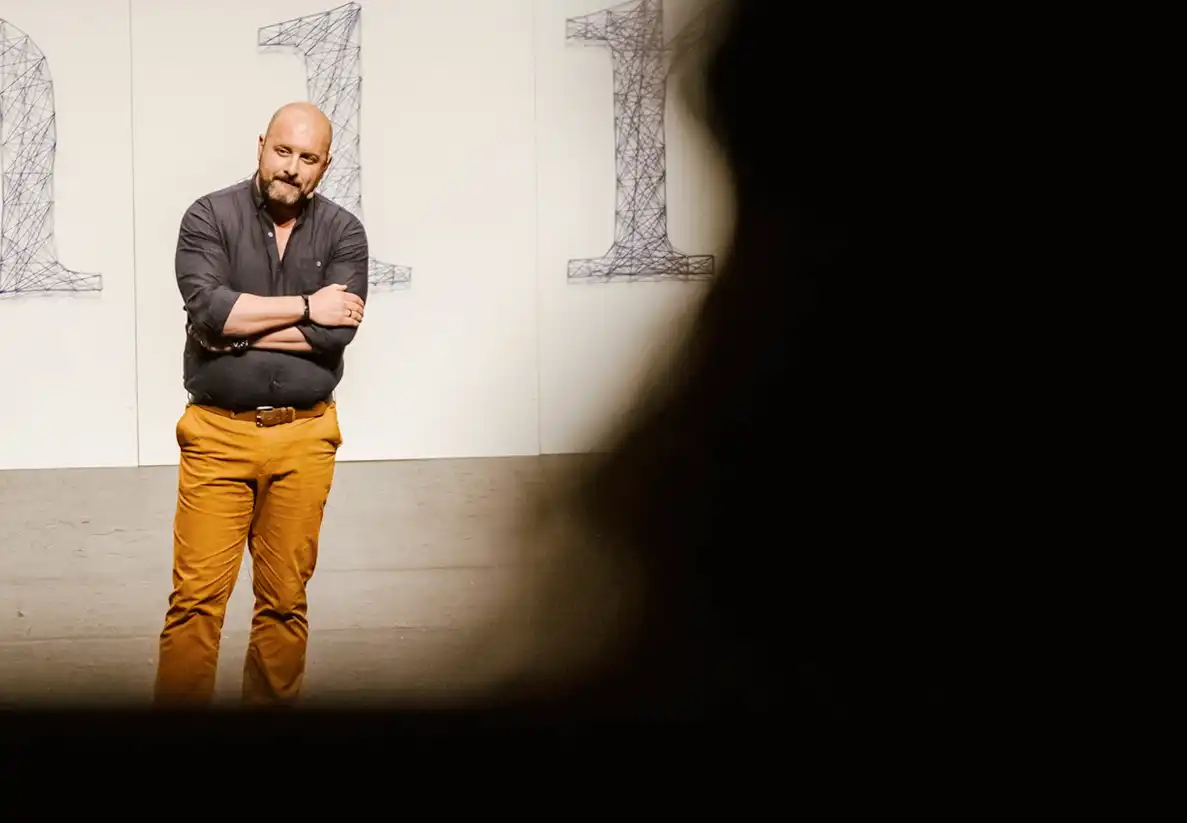
In Mexico City, at a festival of ideas, an elementary-school headteacher from the East Midlands walked onto a concert-sized stage to Kings of Leon. The crowd of several thousand executives had been expecting something institutional. They gave him a standing ovation.
He is, by his own description, a professional troublemaker. His thesis: institutions are systematically brilliant at identifying human potential and then training it out of the people who possess it. His job is to reawaken what was put to sleep.
His thesis, stated plainly, is this: institutions — schools, corporations, governments, sports organisations — are systematically brilliant at identifying human potential and then training it out of the people who possess it. They hire the curious and reward compliance. They recruit the bold and promote the cautious. They celebrate innovation at the strategy day and quietly punish it on the Tuesday that follows. The result, Gerver argues with a precision that borders on the prosecutorial, is that organisations consistently squander the most valuable resource they have — and then commission consultants to solve the mystery of why performance has stalled.
His job, as he has come to define it over twenty-five years, is to reawaken what was put to sleep. He does not run change programmes. He does not sell frameworks. He describes himself, with a brevity that his audiences find both clarifying and faintly unsettling, as an activator.
✦ ✦ ✦
To understand why a former schoolteacher commands the fees and the attention he does, it helps to understand what he actually did in a school. Not because the education chapter of Gerver’s story is the point — it is not — but because it is the proof of concept for everything that followed.
In 2001, Grange Primary School in Long Eaton, on the Nottinghamshire-Derbyshire border, was failing with some commitment. Fewer than half its pupils were achieving benchmark grades. Parents covered their children’s uniforms on the way home to avoid the stigma of being identified as Grange families. Staff were following systems because the systems existed, not because they were producing anything useful. The school sat in the bottom 5% of national rankings. Gerver, then in his early thirties — young enough to alarm the more experienced members of his staff, which he considers one of his early advantages — arrived with three words and a studied refusal to add any more. The school’s new mission: living, learning, laughing. Everything that could not be connected to those three words was, politely but firmly, discontinued.
“Don’t employ anyone over five years old. They’re the only ones still asking the right questions.”
Richard Gerver — his response when a Fortune 500 CEO asked why his “really smart people” couldn’t simplify the business
What followed was not a conventional school improvement programme. Gerver’s instinct — formed, he has explained, by watching what children do when nobody is managing them — was that the problem at Grange was not performance. It was permission. The children had been told, with considerable consistency, what they were likely to become. They had believed it. His job was not to teach them more effectively. It was to give them back the curiosity and courage they had possessed at five, before the systems got to them.

He built Grangeton: a simulated town inside the school, run entirely by the children. A council with an elected mayor. A shop that turned a profit. A radio station that broadcast three times a week. A museum open to the public. A newspaper with full editorial independence. A café run in French. The BBC trained the junior journalists. Local MPs met with the school council. The National Curriculum became, in Gerver’s formulation, a reference point rather than a driver — a description that made some officials uncomfortable and most children considerably more alive to the possibilities of a Tuesday afternoon.
Within two years, Grange moved from the bottom 5% of national rankings to the top 5%. UNESCO came. So did government inspectors, who interviewed a seven-year-old pupil and asked why she liked her school. The child, unprompted, gave an answer that has since travelled further than any of the official reports about the school’s results. “This school is famous,” she told them, “and I made it famous.”
Gerver has told this story many times since, in rooms considerably larger and more expensively furnished than Grange Primary’s hall. The effect on an audience of senior executives is, by reliable account, the same every time. The room goes quiet. Then someone begins to wonder, not quite out loud, what would happen if the people in their organisation felt the same way about the work they were doing. At this point Gerver, who has been waiting for precisely this question, explains that he can help with that.
✦ ✦ ✦
The bridge from the classroom to the corporate stage is, on paper, an improbable one. In practice it was less a career change than a recognition: the slowly forming realisation, as Gerver began to spend time in large organisations after leaving teaching, that the dysfunction he had witnessed at Grange was not peculiar to Grange. It was, with minor variations, everywhere.
“I kept walking into boardrooms,” he has said, “and thinking: I’ve seen this. The staff following systems for no reason other than that the systems exist. The leaders measuring what’s easy to measure rather than what matters. The quiet, collective agreement that the way things are is the way things have to be.” The realisation was not comforting. It was, however, useful. He had already solved the problem once. The method, he suspected, would travel.
It has. Over the two decades since, Gerver has built a keynote and advisory practice that takes him across six continents and into the organisations of Google, Microsoft, Visa, Deloitte, Telefónica, England Rugby, Harvard Business School, Cisco, and a portfolio of governments and Olympic federations. His late mentor Sir Ken Robinson — whose TED talk on creativity remains among the most-watched ever recorded — called him “the practical embodiment of high-thinking on unleashing creativity and potential”: a description that functions simultaneously as an endorsement and a reasonably precise job specification.
His argument in every room is, at its core, the same argument he made at Grange: your people are not the problem. The systems that have slowly trained the curiosity and courage out of them are the problem. The solution is not another system. The solution is to reawaken what your organisation already has and has somehow managed to forget it hired.
“Systems and structures change nothing. People do. I’ve tested this theory at some scale. It holds.”
Richard Gerver — the Gerverism that has become operational shorthand inside hundreds of organisations
 He is not, it should be said, gentle about this. Gerver’s keynotes are not the comfortable affirmations that fill hotel ballrooms across the corporate calendar. He has a habit — disarming rather than aggressive — of making audiences feel simultaneously seen, challenged, and faintly relieved that someone has finally said the thing that needed saying. His delivery is warm, his timing is precise, and his willingness to name the problem in front of the people most responsible for creating it is, by the accounts of those who have hired him, his most commercially valuable quality.
He has also written five books. Change: Learn to Love It, Learn to Lead It argued — in 2013, before disruption became a tired word — that organisations best equipped for an unstable future were those whose people had relearned the childhood instinct to adapt without catastrophising. Simple Thinking followed, making the case with considerable wit that most corporate complexity is not designed but accumulated — the sediment of decades of sensible individual decisions that collectively produce an organisation nobody can navigate. Both remain in print and both are, somewhat against the odds, regularly read by executives who claim not to read business books.
His forthcoming book, Curiosity (Bloomsbury, 2027), extends the argument into the territory that now preoccupies every boardroom with a view to the decade ahead. In a world increasingly shaped by artificial intelligence and a pace of change that has made five-year plans a form of structured optimism, Gerver argues that curiosity — genuine, courageous, childlike curiosity — is not a soft skill. It is the only survival skill that matters.
✦ ✦ ✦
There is a question that event planners and heads of leadership development tend to ask when considering Gerver for a booking, which is whether he can speak to their specific sector, their specific challenge, their specific moment of organisational difficulty. The question is understandable. It is also, by the evidence, somewhat beside the point.
His answer, developed over two decades of walking into rooms where people believe their problems are unique, is that the problems are almost never unique. The technology company that cannot innovate and the professional-services firm that cannot retain its best people and the manufacturer that cannot get its leadership to let go of 2015 are all, at the level that matters, facing the same problem. The same problem Grange Primary had in 2001.
He tailors the surface of every keynote to the room. The spine, he does not change. He has found, over many years and many rooms, that it does not need changing. The human problem — the one where organisations consistently squander the potential they were built to develop — turns out to be stable across sectors, geographies, and org charts.
At some point in most of his keynotes, Gerver asks the room to raise their hands if they were ever five years old. Every hand goes up. He pauses — the pause is calibrated — and then tells them that everything he is about to say belongs, by rights, to them already. That he is not delivering a new idea but returning an old one. The room exhales. It is a small moment. It is not an accidental one. He has been engineering that exhale, in various forms and various rooms, for the better part of twenty-five years.
He loads the spring. Then he lets them go. What they do with it, he says, is the only thing that matters. — R.G.