
Why the organisations that thrive will be the ones that protect and amplify human curiosity
There is a fascinating paradox at the heart of the AI revolution.
The more technologically capable we become, the more important our humanity becomes.
Yet much of the conversation about preparing people for an AI-powered future is focused on technical capability.
We talk about prompting.
Coding.
Data.
Automation.
Digital literacy.
Machine learning.
AI fluency.
And rightly so.
People need to understand the tools that are transforming the way we work.
But I believe there is another capability that is going to become even more important.
And it is one we have been in danger of undervaluing for years.
Curiosity.
Not curiosity as a nice characteristic.
Not curiosity as something we associate with children.
But curiosity as a strategic organisational capability.
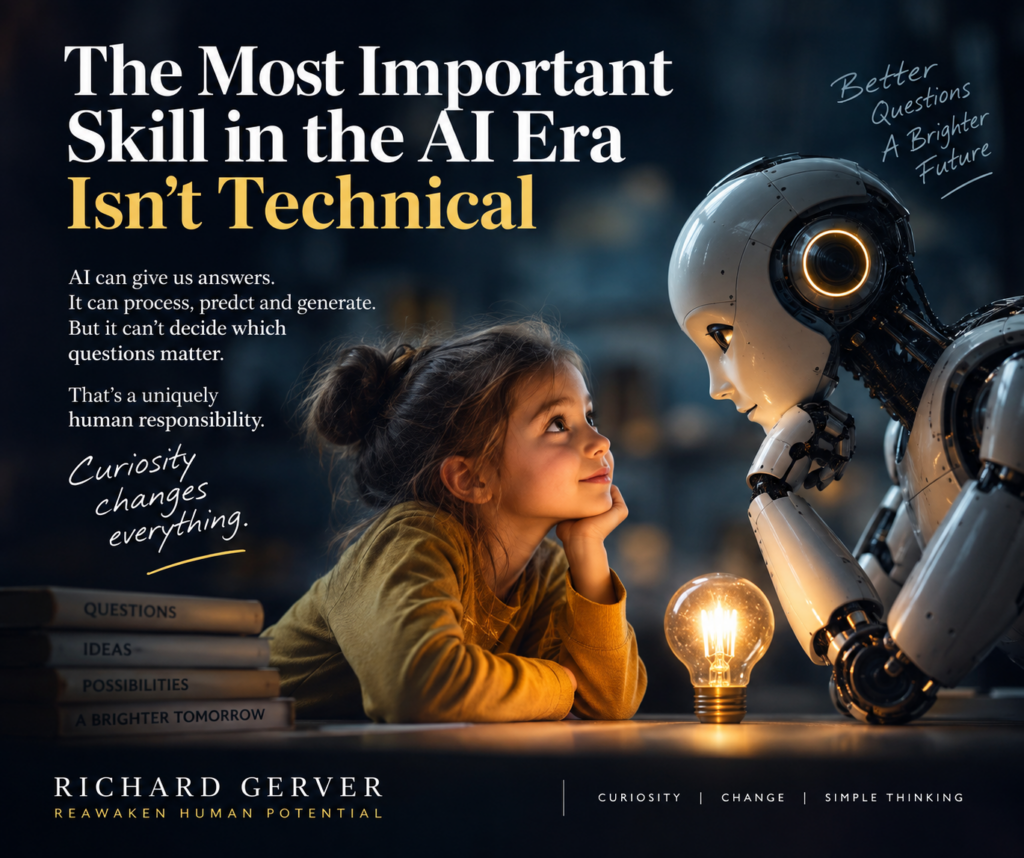
Because if AI becomes extraordinarily good at answering questions, then the quality of the questions humans ask becomes increasingly important.
We have become obsessed with answers
Think about how organisations traditionally reward expertise.
We employ people because they know things.
We build systems around accumulated knowledge.
We create processes to standardise behaviour.
We measure performance.
We seek predictability.
We reward people for getting things right.
All of this has obvious value.
But there is a hidden danger.
We can become so focused on knowing the answer that we stop asking whether we’re asking the right question.
That matters enormously in a world where the answers are changing faster than ever.
The future doesn’t arrive as a neat presentation.
It arrives messy.
Unexpectedly.
Often inconveniently.
The assumptions that made sense five years ago may no longer make sense today.
The customer has changed.
The technology has changed.
The workforce has changed.
The market has changed.
And yet organisations can remain trapped by the assumptions that built their previous success.
This is where curiosity becomes much more than a personality trait.
It becomes a form of organisational resilience.
The curiosity paradox
One of the things that has fascinated me throughout my career is that young children are naturally curious.
They ask extraordinary questions.
They investigate.
They experiment.
They make mistakes.
They try again.
They aren’t particularly concerned about looking foolish.
And then something happens.
We educate them.
We employ them.
We organise them.
We measure them.
We manage them.
And gradually, many learn to become more cautious.
They learn when it is appropriate to speak.
They learn that some answers are considered better than others.
They learn that mistakes can have consequences.
They learn that there is often a correct way of doing things.
Eventually, some of the people who once asked hundreds of questions a day become adults who hesitate before asking one.
This isn’t because they have lost their intelligence.
It is because the environment has taught them to protect it.
And I think organisations need to pay much more attention to that.
The opposite of curiosity isn’t ignorance
It is tempting to think that curious people are simply people who don’t know enough.
I think the opposite is often true.
The most curious people I know are frequently the most knowledgeable.
Why?
Because knowledge has taught them how much more there is to discover.
The opposite of curiosity isn’t ignorance.
It’s certainty.
Certainty tells us:
“We already know.”
Curiosity asks:
“What might we be missing?”
Certainty protects the existing model.
Curiosity tests it.
Certainty seeks confirmation.
Curiosity seeks discovery.
And in a world of rapid change, that distinction could become one of the most important cultural distinctions an organisation makes.
AI makes this more important, not less
There is a misconception that AI will make curiosity less important because machines can do so much of the searching and thinking for us.
I believe the opposite is true.
Imagine that tomorrow your organisation has access to an AI system capable of analysing millions of pieces of information in seconds.
It can identify patterns.
Generate scenarios.
Summarise research.
Produce reports.
Write strategies.
Suggest solutions.
Now ask yourself:
Who decides what the system should investigate?
Who decides which problem is worth solving?
Who recognises an opportunity that isn’t yet obvious?
Who notices that the question itself might be wrong?
Who brings imagination, experience, empathy and moral judgement to the decision?
Who asks:
“What if we looked at this completely differently?”
The technology can dramatically expand our capacity.
But it doesn’t remove the need for human judgement.
It makes it more important.
The future belongs to better question-askers
I increasingly believe that one of the great competitive advantages of the next decade will be an organisation’s ability to generate better questions.
Not simply more questions.
Better ones.
Questions that challenge assumptions.
Questions that open possibilities.
Questions that expose blind spots.
Questions that connect people.
Questions that make us uncomfortable.
Questions that force us to reconsider what we thought we knew.
Questions such as:
What if we’re wrong?
What are our customers struggling with that they aren’t telling us?
What are we protecting that no longer needs protecting?
What would we attempt if failure wasn’t embarrassing?
What don’t we know that we don’t know?
And perhaps the most important:
What could become possible if we stopped assuming that the future has to look like the past?
But curiosity needs an environment
This is where leadership becomes critical.
You can’t simply tell people to “be more curious.”
Curiosity is profoundly affected by culture.
If people are punished for challenging the boss, they will stop challenging the boss.
If experimentation is celebrated only when it succeeds, people will stop experimenting.
If mistakes are treated as evidence of incompetence, people will hide them.
If asking questions is interpreted as a lack of expertise, people will learn to remain silent.
If leaders constantly provide the answer, people eventually stop searching for one themselves.
Curiosity requires psychological permission.
It requires leaders who can say:
“I don’t know.”
It requires teams that can say:
“Let’s find out.”
It requires cultures where being wrong isn’t the end of the conversation.
It is the beginning of a better one.
We need to stop preparing people for certainty
For generations, much of education and organisational life has been built around preparing people to know.
Know the facts.
Know the process.
Know the answer.
Know the rules.
But the future is asking something different of us.
It is asking us to become comfortable with not knowing.
That doesn’t mean abandoning expertise.
Quite the opposite.
Expertise gives us the foundation from which curiosity can operate.
But expertise without curiosity can become a prison.
The person who knows everything has nowhere left to go.
The person who understands that there is always more to discover has infinite possibilities.
Curiosity creates courage
There is another important relationship here.
Curiosity doesn’t just create better questions.
It can create courage.
Once you become genuinely curious about something, you become willing to investigate it.
You become willing to test it.
You become willing to discover that your original assumption was wrong.
And that requires humility.
The courage to say:
“I might not know.”
The courage to say:
“I might be wrong.”
The courage to say:
“Let’s try.”
These aren’t weaknesses.
In a rapidly changing world, they are extraordinary strengths.
The organisations that win
So what will the successful organisations of the AI era look like?
I don’t think they will necessarily have the most sophisticated technology.
They won’t necessarily have the biggest budgets.
They won’t necessarily employ the most technically gifted people.
I think they will be organisations where technology and humanity amplify one another.
Where AI handles what machines are increasingly brilliant at doing.
And humans spend more time doing what humans can uniquely contribute.
Imagining.
Questioning.
Connecting.
Creating.
Caring.
Judging.
Challenging.
Discovering.
And making meaning.
The goal isn’t to compete with machines.
It is to become more human because machines can do more of the mechanical work.
Reawakening curiosity
Perhaps this is why I keep coming back to the idea of reawakening.
Because I don’t believe we need to manufacture curiosity.
It is already there.
I see it in children.
I see it in brilliant entrepreneurs.
I see it in great teachers.
I see it in extraordinary leaders.
I see it in teams when they are given permission to experiment.
What we need to do is create the conditions in which curiosity can flourish again.
That means changing the questions leaders ask.
Changing the way we respond to mistakes.
Changing how we define expertise.
Changing how we reward people.
Changing how we think about learning.
And perhaps, most importantly, changing our relationship with uncertainty.
Because uncertainty isn’t simply something to eliminate.
It is where possibility lives.
So what should leaders do?
Start small.
At your next leadership meeting, instead of asking:
“What’s the answer?”
ask:
“What are we assuming?”
Instead of:
“Who made the mistake?”
ask:
“What can this teach us?”
Instead of:
“How do we manage this change?”
ask:
“What capability do our people need to navigate it?”
Instead of:
“How do we make AI more efficient?”
ask:
“What could our people do if AI gave them back the time?”
And instead of asking whether your organisation is ready for the future, ask:
“Are we creating a culture capable of discovering what the future requires?”
Because we don’t know what the future will demand.
And that’s precisely the point.
The most important skill may be the willingness to keep learning
AI will undoubtedly make technical skills more important in some areas.
It will create entirely new disciplines.
It will change jobs.
It will eliminate some tasks and create others.
But beneath all of that sits something more fundamental.
The capacity to remain curious.
To remain open.
To remain willing to learn.
To challenge what we think we know.
To discover what we don’t.
That is not an alternative to technical capability.
It is what makes technical capability useful.
The great opportunity of the AI era isn’t simply to build smarter machines.
It is to build more curious humans and more curious organisations.
Because AI can give us answers.
It can’t decide which questions matter.
And perhaps that is where our greatest human advantage begins.
What makes your heart beat a little faster?
That is the question I would leave leaders with.
Not:
“What do you know?”
But:
“What are you curious enough to discover?”
Because the future doesn’t belong to those who already have all the answers.
It belongs to those courageous enough to keep asking better questions.


