For much of my career, I have been fascinated by a simple question:
What are human beings capable of when we believe more is possible?
I first encountered the answer in education.
I saw what happened when children were given permission to ask questions, make mistakes, experiment, create and discover. I saw what happened when adults stopped trying to control every outcome and started creating the conditions for people to take ownership of their learning.
Over the years, I have come to realise that the same principles apply far beyond education.
They apply to leadership.
To organisations.
To innovation.
To culture.
And, perhaps more importantly than ever, to the way we respond to change.
We are living through a period in which the pace of change is extraordinary. Artificial intelligence is transforming work. Technology is reshaping industries. Expectations are changing. Information is everywhere. Certainty is becoming increasingly difficult to find.
And yet, when faced with uncertainty, our instinct is often to do the opposite of what we need.
We try to control more.
We create more processes.
We seek more information.
We look for definitive answers.
We become more cautious.
In other words, we often respond to uncertainty by becoming less curious.
I believe we need to reverse that.
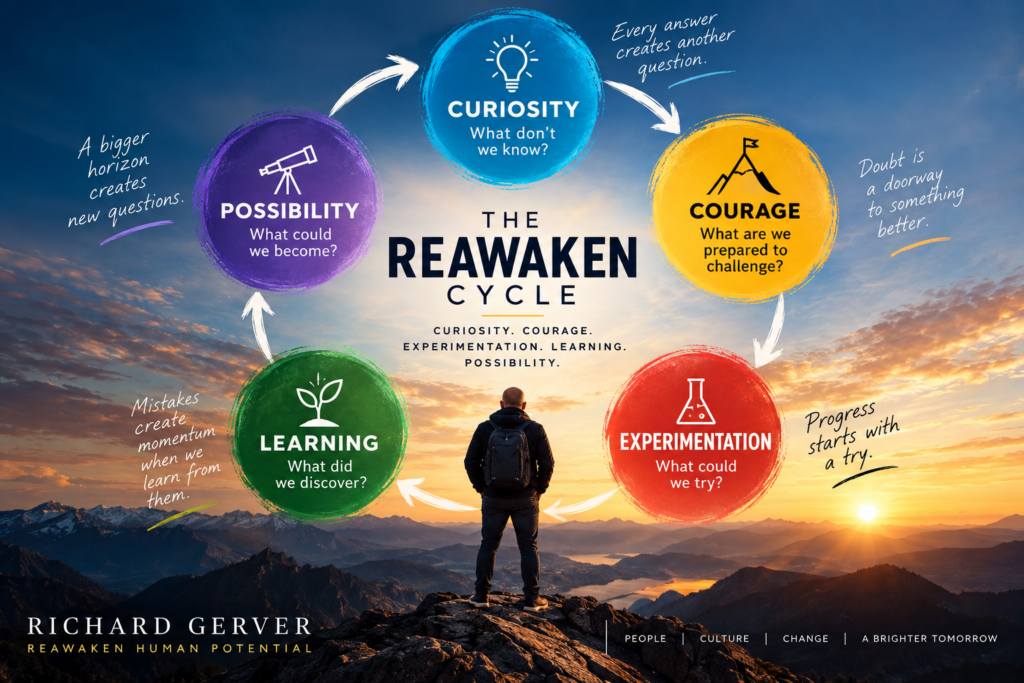
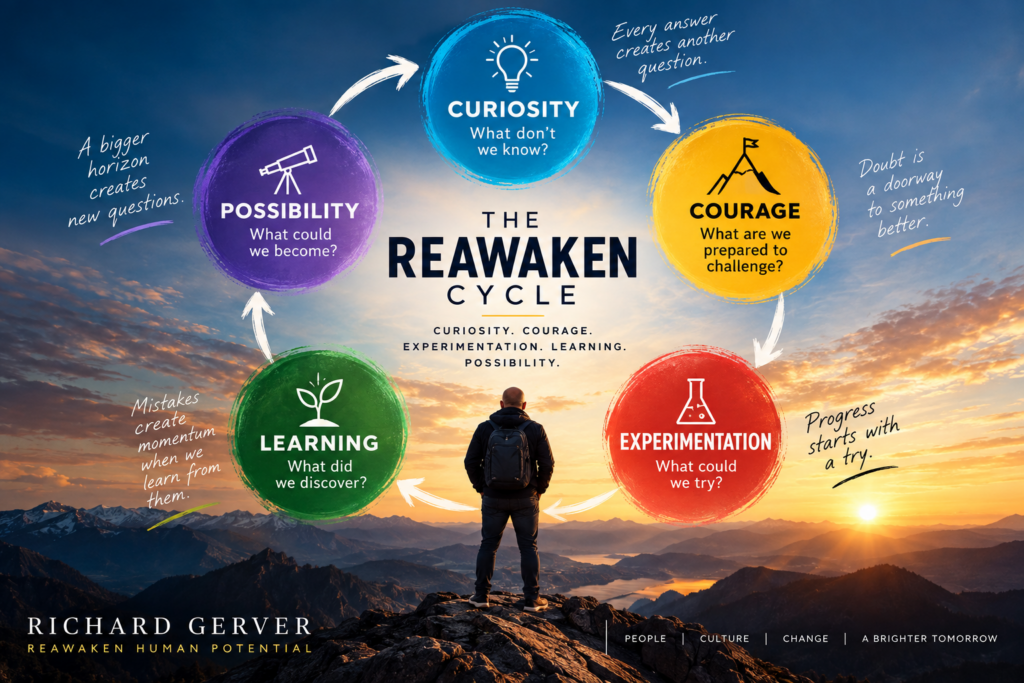
That is why I have developed what I call The Reawaken Cycle.
It is a simple framework built around five interconnected behaviours:
CURIOSITY → COURAGE → EXPERIMENTATION → LEARNING → POSSIBILITY
And then back to curiosity.
It isn’t a linear process.
It is a cycle.
Because every answer should create another question.
1. CURIOSITY
What don’t we know?
Everything starts here.
Curiosity is the willingness to look at something and think:
“I wonder…”
It is one of the first behaviours we see in children.
A five-year-old doesn’t look at the world and assume they understand it.
They investigate it.
Why?
Why not?
What happens if?
What’s that?
How does that work?
And then, famously, they ask why again.
And again.
And again.
Somewhere along the way, many of us learn to stop.
We become experts.
We become busy.
We become comfortable with our assumptions.
We start to believe that because we have seen something before, we understand it.
But experience can be dangerous when it becomes certainty.
The world doesn’t owe our previous experience any loyalty.
What worked yesterday might not work tomorrow.
What made sense five years ago might now be holding us back.
So the first step of the Reawaken Cycle is deliberately uncomfortable:
What don’t we know?
Not what do we know?
Not what is the answer?
But:
What are we missing?
For leaders, this can be transformational.
Instead of entering a meeting determined to prove that they are right, they enter wondering what they might have overlooked.
Instead of asking their people for solutions immediately, they ask better questions.
Instead of saying:
“This is how we’ve always done it.”
They ask:
“Why do we do it this way?”
Curiosity opens the door.
But it isn’t enough to open the door.
At some point, we have to walk through it.
And that requires courage.
2. COURAGE
What are we prepared to challenge?
Curiosity is easy when the answers don’t threaten us.
It becomes much harder when they do.
What happens when curiosity reveals that our strategy isn’t working?
Or that our customers have changed?
Or that our assumptions are wrong?
Or that our leadership behaviour is part of the problem?
Or that the thing we have invested millions in isn’t delivering what we hoped?
This is where courage becomes essential.
Courage isn’t the absence of uncertainty.
It is the willingness to move forward while uncertainty still exists.
One of the most powerful phrases a leader can say is:
“I don’t know.”
It doesn’t make them weaker.
It makes them human.
And when a leader can say “I don’t know, but let’s find out,” something extraordinary can happen.
Other people become more willing to contribute.
They become more willing to admit what they don’t know.
They become more willing to challenge assumptions.
They become more willing to experiment.
Courage creates permission.
And permission creates possibility.
But courage also means being willing to challenge ourselves.
We often talk about courageous leadership as if it means making bold decisions.
Sometimes it does.
But sometimes the most courageous thing a leader can do is ask:
“What if I am wrong?”
That question can change everything.
Because once we accept that we might be wrong, experimentation becomes possible.
3. EXPERIMENTATION
What could we try?
This is where ideas become action.
One of the biggest mistakes organisations make is believing that every new idea needs to be perfect before it can be attempted.
It doesn’t.
In fact, waiting for certainty can be one of the biggest barriers to innovation.
Experimentation gives us another option.
Try something.
Observe what happens.
Learn.
Adjust.
Try again.
This doesn’t mean being reckless.
There is a huge difference between experimentation and irresponsibility.
Good experimentation is intentional.
It is based on a hypothesis.
It has boundaries.
It has a purpose.
And, critically, it creates information.
The experiment doesn’t have to succeed to be valuable.
It simply has to teach us something.
This is one of the reasons I believe our relationship with mistakes needs to change.
We have created cultures where people often feel that making a mistake is evidence that they aren’t good enough.
But if we want innovation, we need to recognise that some mistakes are simply the price of discovery.
The question isn’t:
“Did you fail?”
The better question is:
“What did you discover?”
That takes us to the fourth part of the cycle.
4. LEARNING
What did we discover?
Learning is where experience becomes insight.
But simply having an experience doesn’t mean we have learned from it.
We can repeat the same mistake for twenty years.
Experience only becomes useful when we reflect upon it.
That means asking:
What happened?
Why did it happen?
What surprised us?
What did we assume?
What did we get wrong?
What did we learn?
What would we do differently?
And perhaps:
What have we discovered that we couldn’t have known before we tried?
This is particularly important in an age of AI.
We now have access to extraordinary amounts of information.
But information isn’t the same as learning.
Learning requires interpretation.
It requires reflection.
It requires context.
It requires us to connect information with experience and judgement.
And it requires humility.
Because genuine learning sometimes means accepting that the thing we believed yesterday isn’t the thing we believe today.
That isn’t failure.
That’s growth.
And when learning happens properly, something extraordinary emerges.
Possibility.
5. POSSIBILITY
What could we become?
This is the part of the cycle that I find most exciting.
Because learning doesn’t simply tell us what happened.
It changes what we believe is possible.
A child learns to walk because they keep experimenting.
They fall.
They adjust.
They try again.
Eventually, something that once seemed impossible becomes ordinary.
Organisations work in much the same way.
A team tries something new.
It doesn’t work exactly as expected.
They learn.
They adapt.
They discover a new capability.
And suddenly they can imagine something they couldn’t imagine before.
That’s the power of possibility.
It expands the horizon.
And once the horizon expands, curiosity returns.
We start asking:
If that is possible, what else might be possible?
And the cycle begins again.
Why I call it a cycle
This is perhaps the most important part of the model.
It isn’t:
Curiosity → Courage → Experimentation → Learning → Done.
There is no “done.”
Because the world isn’t finished.
Every answer generates another question.
Every discovery reveals another unknown.
Every successful experiment creates another possibility.
Every new capability changes what we are capable of attempting.
So we return to curiosity.
What don’t we know now?
That is why I call it the Reawaken Cycle.
Because I don’t believe curiosity needs to be manufactured.
I think much of it is already inside us.
We simply need to create the conditions that allow it to come back to life.
The leadership challenge
This is where the Reawaken Cycle becomes particularly powerful for leaders.
Because leaders don’t simply participate in the cycle.
They create the conditions for other people to participate in it.
Think about the messages an organisation sends every day.
What happens when somebody asks a difficult question?
What happens when somebody challenges a senior leader?
What happens when an experiment doesn’t work?
What happens when somebody admits they don’t know?
What happens when a junior member of the team has an idea that contradicts the established view?
What happens when somebody says:
“I think we’re looking at this the wrong way.”
Those moments tell you more about your culture than almost any employee survey.
If the response is:
“That’s interesting. Let’s explore it.”
You have a curious culture.
If the response is:
“We’ve tried that before.”
You may have a culture of certainty.
If the response is:
“Don’t question the strategy.”
You have a culture where curiosity has become dangerous.
And once curiosity becomes dangerous, people stop being curious.
They simply become compliant.
The Reawaken Cycle in the age of AI
There is another reason I think this framework matters now.
Artificial intelligence is changing the relationship between humans and knowledge.
For generations, possessing knowledge was a significant source of power.
Now machines can retrieve, process and generate vast amounts of information incredibly quickly.
That doesn’t make human thinking irrelevant.
It makes the quality of our thinking more important.
AI can help us explore possibilities.
But we still need to decide which possibilities are worth exploring.
It can generate answers.
But we need to decide which questions matter.
It can identify patterns.
But humans still need to determine what those patterns mean.
It can produce options.
But we need judgement, context, empathy and imagination to choose between them.
So perhaps the most important capability in the AI era isn’t simply technical proficiency.
Perhaps it is our ability to remain curious enough to use technology intelligently.
AI can give us answers.
It can’t decide which questions matter.
Reawakening doesn’t mean becoming childish
People sometimes misunderstand the idea of becoming more like a five-year-old.
I don’t mean becoming immature.
I mean recovering some of the behaviours we possessed before we became frightened of looking foolish.
The willingness to ask.
The willingness to explore.
The willingness to play.
The willingness to say:
“I don’t know.”
The willingness to try.
The willingness to fail.
The willingness to begin again.
These are not childish qualities.
They are deeply human ones.
And perhaps we have spent too much time trying to educate them out of ourselves.
A practical challenge for leaders
So here’s my challenge.
At your next leadership meeting, don’t begin with the answers.
Begin with five questions.
CURIOSITY
What don’t we know?
COURAGE
What are we assuming that might be wrong?
EXPERIMENTATION
What could we try rather than simply discuss?
LEARNING
What will we learn regardless of the outcome?
POSSIBILITY
If this works, what might become possible?
Then ask the most important question of all:
What question should we be asking that nobody in this room has asked yet?
That question might be worth more than another hour of PowerPoint.
The world doesn’t need more certainty
I think we have become obsessed with certainty.
We want five-year plans.
Predictable outcomes.
Guaranteed returns.
Perfect strategies.
Risk-free innovation.
But the future doesn’t work like that.
We cannot know everything.
We cannot control everything.
We cannot predict everything.
And we certainly cannot eliminate uncertainty.
So perhaps our ambition should change.
Instead of trying to build organisations that know exactly what to do in every situation, we should build organisations capable of figuring out what to do when the situation changes.
That is a very different proposition.
It requires curiosity.
It requires courage.
It requires experimentation.
It requires learning.
And it requires a belief in possibility.
Reawaken
The Reawaken Cycle is ultimately about something much bigger than business.
It is about how we remain human in a world that is becoming increasingly complex and technological.
It is about refusing to allow uncertainty to turn into fear.
It is about seeing mistakes as information.
It is about creating cultures where people can challenge, question and explore.
It is about leaders understanding that their job isn’t to have all the answers.
Their job is to create the conditions in which better answers can be discovered.
And it is about recognising that curiosity isn’t something we should leave behind when we grow up.
We need it more than ever.
Because the future is going to ask questions that none of us can answer today.
And that means our greatest advantage may not be knowing what comes next.
It may be having the courage and curiosity to discover it.
The Reawaken Cycle
CURIOSITY
What don’t we know?
↓
COURAGE
What are we prepared to challenge?
↓
EXPERIMENTATION
What could we try?
↓
LEARNING
What did we discover?
↓
POSSIBILITY
What could we become?
↓
CURIOSITY
And round we go.
Because every ending is another beginning.
Every answer is another question.
Every discovery opens another door.
And perhaps the real challenge for all of us isn’t to prepare for a future we can predict.
It is to become the kind of people and create the kind of cultures capable of discovering what we don’t yet know.
That’s what I mean by Reawakening.