Why me, why now?
The Curiosity Expert
I find myself at the intersection of Curiosity, Change, Learning and Human Potential
1. THE CENTRAL POSITIONING
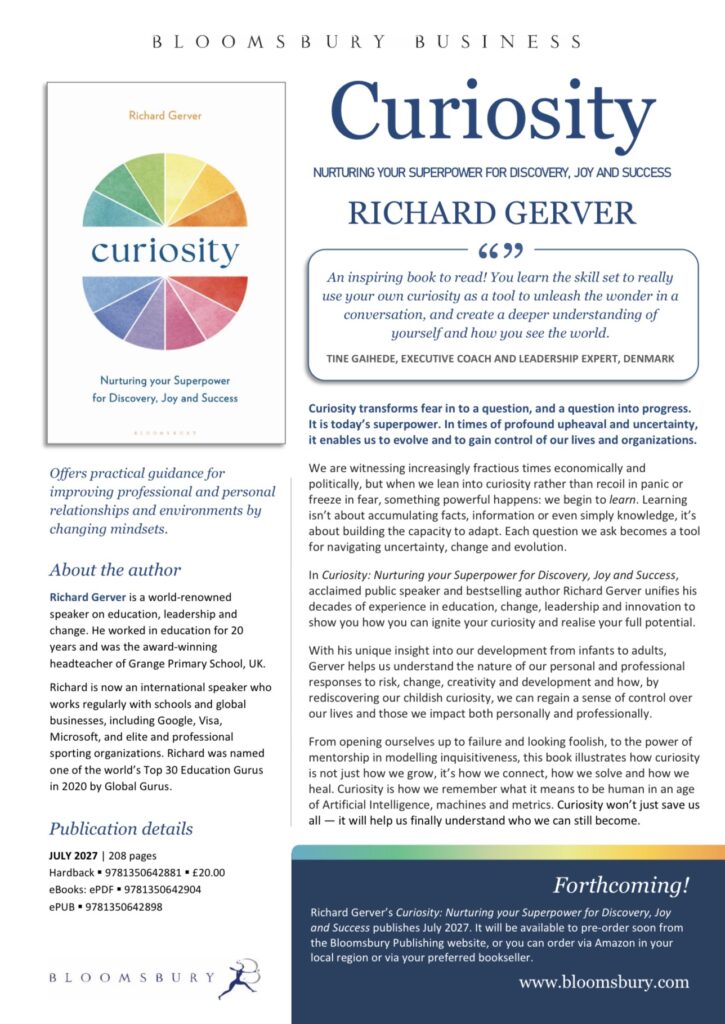
Richard Gerver is a leading international thinker and speaker on curiosity, change, learning and human potential.
For more than two decades, Richard has explored what happens when people and organisations are given the confidence, permission and tools to question what they think they know — and to discover what they don’t yet know.
His work is increasingly centred on a simple but profound proposition:
Curiosity is not simply the desire to know more. It is the human capacity that enables us to navigate what we don’t yet know.
In a world defined by artificial intelligence, rapid technological change, polarisation, uncertainty and increasing complexity, Richard argues that curiosity is becoming one of the most important capabilities individuals, leaders and organisations can develop.
His work brings together four interconnected ideas:
Curiosity → Learning → Change → Human Potential
And his overarching philosophy is:
REAWAKENING
Curiosity. Change. Simplicity.
2. THE BIG IDEA
We have become very good at knowing.
But the future increasingly belongs to people who are comfortable not knowing.
For much of our lives, education, business and society have rewarded certainty.
We learn the answer.
We pass the test.
We follow the process.
We become the expert.
We build systems designed to make things predictable.
But today’s world is increasingly unpredictable.
Artificial intelligence can provide answers almost instantly.
Information is abundant.
Technology is accelerating.
Jobs are changing.
Markets are shifting.
Social and political divisions are deepening.
The problem is no longer simply:
“What do we know?”
Increasingly, the question is:
“How good are we at discovering what we don’t yet know?”
That is where curiosity becomes transformational.
3. RICHARD’S DISTINCTIVE THESIS
Richard’s work challenges the conventional view of curiosity as a personality trait or a desirable characteristic.
He positions curiosity as a strategic human capability.
Curiosity enables us to:
- question assumptions
- challenge certainty
- see different perspectives
- learn continuously
- adapt to change
- experiment
- take intelligent risks
- collaborate
- understand rather than simply judge
- identify opportunities
- imagine alternatives
- develop new ideas
- remain open to possibility
In this sense, curiosity isn’t an optional extra.
It is part of the infrastructure of human adaptability.
4. WHY RICHARD GERVER?
Richard’s credibility comes from the combination of experience, storytelling, education, organisational change and practical application.
He isn’t a theorist talking about curiosity from a distance.
His career has repeatedly placed him inside environments where people have had to deal with uncertainty, transformation, performance and change.
His work has taken him from education into the worlds of business, leadership and organisational transformation.
He has spent decades working with leaders, educators and organisations internationally, examining what makes people capable of adapting, learning and performing when the future isn’t clear.
His experience gives him a distinctive perspective:
Richard understands both sides of the equation.
How do we help people learn?
And:
How do we help organisations change?
Curiosity sits at the intersection.
5. THE FIVE-YEAR-OLD QUESTION
One of Richard’s most distinctive ideas is deceptively simple:
What happened to the five-year-old we used to be?
Five-year-olds ask questions constantly.
Why?
Why not?
What happens if?
Can I?
What is that?
What would happen if we did this?
They experiment.
They play.
They fail.
They try again.
They don’t automatically accept that something cannot be done.
Then something happens.
We educate them.
We socialise them.
We organise them.
We teach them to look for the right answer.
And gradually, many adults become more concerned with being right than being curious.
Richard’s work is not about turning adults back into children.
It is about reclaiming the useful characteristics of childhood without abandoning the wisdom of adulthood.
That is the essence of Reawakening.
6. THE REAWAKENING PHILOSOPHY
REAWAKENING
Curiosity. Change. Simplicity.
Richard’s emerging body of work argues that modern life has become unnecessarily complicated.
We have accumulated:
- information
- processes
- bureaucracy
- assumptions
- technology
- competing priorities
- organisational complexity
- fear of failure
- fear of uncertainty
And yet some of the most powerful human capabilities remain remarkably simple.
Be curious.
Ask better questions.
Listen.
Experiment.
Learn.
Connect.
Play.
Take a risk.
Try again.
Richard calls this process Reawakening.
It is about rediscovering the human capabilities that allow us to thrive in a world that increasingly refuses to behave predictably.
7. CURIOSITY IN THE AGE OF AI
This is where Richard’s thinking becomes particularly relevant to the corporate world.
AI changes the value of knowledge.
If machines can increasingly retrieve, process, analyse and generate information, then simply knowing things becomes less distinctive.
The uniquely human advantage increasingly lies in our ability to:
question, imagine, interpret, connect, challenge and decide.
AI can answer a question.
But who decides which question is worth asking?
AI can generate possibilities.
But who decides which possibility matters?
AI can identify patterns.
But who understands the human meaning behind them?
AI can produce content.
But who determines the purpose?
Richard’s central proposition for the AI era is therefore:
The more powerful our technology becomes, the more important our humanity becomes.
And curiosity is one of the mechanisms through which we express that humanity.
8. CURIOSITY AND LEADERSHIP
Richard argues that the best leaders are not necessarily those with the most answers.
They are often the leaders who ask the best questions.
A curious leader asks:
What are we missing?
What are we assuming?
Who sees this differently?
What haven’t we considered?
What would happen if we were wrong?
What can we learn from this?
What does our customer know that we don’t?
What are our people seeing that we aren’t?
This creates a different kind of leadership culture.
Instead of:
Leader → answer → instruction
Richard advocates:
Leader → question → exploration → learning → action
Curiosity therefore becomes a leadership behaviour, not merely an individual personality trait.
9. CURIOSITY AND CHANGE
One of Richard’s strongest areas of expertise is the relationship between curiosity and change.
People often resist change because they perceive it as a threat.
They don’t understand what is happening.
They don’t feel in control.
They fear losing something.
They don’t trust the people leading it.
Curiosity creates another possibility.
Instead of asking:
“How do we get people to accept change?”
Richard asks:
“How do we help people become curious about what change might make possible?”
That is a fundamental shift.
Change stops being something done to people and becomes something they can explore, influence and shape.
10. CURIOSITY AND CULTURE
Curiosity cannot simply be demanded.
Organisations cannot tell people:
“We want you to be innovative.”
while simultaneously punishing mistakes.
They cannot demand:
“Challenge us.”
while rewarding compliance.
They cannot say:
“Think differently.”
while making every decision according to precedent.
Richard therefore argues that leaders must build cultures where curiosity is safe, valued and useful.
That means creating environments where people can:
- ask difficult questions
- challenge assumptions
- admit they don’t know
- experiment
- make intelligent mistakes
- learn from failure
- listen to different perspectives
- explore possibilities
- challenge established thinking
The culture has to match the rhetoric.
11. THE “AWESOME QUESTIONS” PRINCIPLE
A recurring element of Richard’s work is the importance of better questions.
Not simply questions designed to extract information.
Questions designed to open thinking.
For example:
Why do you believe that?
Why is that important to you?
What might we be missing?
What would someone who disagrees with us say?
Why do you think I’m wrong?
What if our assumption is incorrect?
These questions create space.
They slow down certainty.
They invite dialogue.
And they create the conditions for learning.
Richard’s argument is simple:
The quality of our questions determines the quality of the possibilities we can see.
12. RICHARD’S INTELLECTUAL TERRITORY
Richard should increasingly own the following territory:
CURIOSITY
The capability to explore what we don’t yet know.
CHANGE
The ability to navigate uncertainty and turn disruption into possibility.
LEARNING
The mechanism through which individuals and organisations adapt.
SIMPLICITY
The discipline of stripping away unnecessary complexity so people can focus on what matters.
HUMAN POTENTIAL
The belief that people are capable of far more when environments encourage exploration rather than compliance.
These ideas form a coherent intellectual ecosystem.
13. SIGNATURE MODEL
THE REAWAKEN CYCLE
Richard’s thinking can be expressed through a simple cycle:
QUESTION
Challenge assumptions.
↓
EXPLORE
Become genuinely curious.
↓
EXPERIMENT
Try something.
↓
LEARN
Understand what happened.
↓
ADAPT
Change your thinking or behaviour.
↓
REIMAGINE
See new possibilities.
↓
QUESTION AGAIN
The cycle continues.
This is not a linear process.
It is a human operating system for uncertainty.
14. THE CORPORATE PROPOSITION
For business leaders, Richard’s proposition is particularly relevant because organisations increasingly face a paradox.
They need people who can:
- innovate
- adapt
- collaborate
- challenge
- learn
- anticipate
- experiment
But many organisations have cultures that unintentionally encourage the opposite.
Richard helps leaders close that gap.
His work asks:
How do we create people and cultures capable of discovering what they don’t yet know?
That question can sit at the heart of his corporate positioning.
15. THE EDUCATION PROPOSITION
Richard’s education work provides the foundation for much of his thinking.
Schools are not simply places where children acquire knowledge.
They are environments where children develop their relationship with learning itself.
The challenge is therefore not just:
How much do children know?
It is:
Do they still want to know more?
Richard challenges educators to protect curiosity while developing knowledge, skills and judgement.
His argument is that future-ready education must develop people who can:
- ask
- explore
- collaborate
- create
- adapt
- evaluate
- experiment
- learn continuously
The same capabilities increasingly matter in the workplace.
16. SIGNATURE SPEAKING POSITION
Richard should not be marketed simply as:
“A keynote speaker on curiosity.”
A stronger proposition is:
Richard Gerver helps leaders and organisations reawaken the human capabilities they need to thrive in a world of constant change.
His signature keynote can then sit underneath this:
REAWAKENING
How Curiosity, Change and Simplicity Will Shape Our Future
Other keynote titles could include:
The Curiosity Advantage
Why the ability to discover what we don’t know is becoming the ultimate human capability.
The Future Belongs to the Curious
How curiosity, learning and experimentation create organisations capable of adapting to change.
Human in the Age of AI
Why technology makes curiosity, creativity and human judgement more important — not less.
The Five-Year-Old Inside Your Organisation
What leaders can learn from the natural curiosity we lose as we grow up.
Leading Through the Unknown
Why the best leaders don’t have all the answers — they create the conditions for better questions.
Reawakening
Curiosity, Change and Simplicity in a World That Won’t Stop Changing.
17. THE ONE-SENTENCE VERSION
When someone asks:
“What does Richard Gerver actually talk about?”
The answer should be:
Richard Gerver helps people and organisations become more curious, adaptable and human in a world of accelerating change.
18. THE 30-SECOND VERSION
Richard Gerver is an internationally recognised speaker, author and thinker on curiosity, change, learning and human potential. His work explores how individuals and organisations can become better at navigating uncertainty by developing the curiosity, confidence and creativity to discover what they don’t yet know. Through his Reawakening philosophy, Richard challenges leaders to simplify, question assumptions and create cultures where people are empowered to learn, experiment and adapt.
19. THE US CORPORATE POSITIONING
For the US market, the language should be slightly more commercially focused.
Recommended positioning:
Richard Gerver is a leading international voice on curiosity, human potential and navigating change in the age of AI.
Then:
For more than two decades, Richard has worked with leaders and organisations around the world, helping them understand what it takes to create cultures that can learn, adapt and thrive in uncertain times.
And then the hook:
His central question is simple: How do we create people and cultures capable of discovering what they don’t yet know?
That question is highly relevant to CEOs, CHROs, learning leaders, education leaders and organisations navigating AI-driven transformation.
20. PROOF POINTS
Richard’s credibility should be communicated through evidence rather than exaggerated claims.
Key proof points include:
- International speaking experience.
- More than two decades working across education, leadership and organisational change.
- Experience of leading transformational change.
- Work with major organisations and leadership teams.
- Author of Change.
- Author of Simple Thinking.
- Extensive work with educators and education systems.
- Development of a distinctive body of thinking around curiosity and change.
- Development of the Reawakening philosophy.
- Practical experience translating ideas into organisational behaviour.
- A highly distinctive storytelling-based speaking style.
Where possible, these should be supported by specific client names, outcomes, testimonials, media appearances and measurable examples.
21. THE LANGUAGE TO OWN
Richard should repeatedly use a small number of memorable phrases.
Core phrases
“Discovering what we don’t yet know.”
“The quality of our questions determines the quality of our possibilities.”
“Curiosity is the beginning of adaptability.”
“The more powerful technology becomes, the more important our humanity becomes.”
“We don’t need to become children again. We need to reclaim some of what we were born knowing.”
“Change becomes less threatening when people have agency within it.”
“Curiosity turns uncertainty from a threat into an invitation.”
“The future doesn’t belong to those who know everything. It belongs to those who are willing to keep learning.”
22. WHAT RICHARD SHOULD NOT BECOME
There is an important strategic discipline here.
Richard should avoid becoming:
“The curiosity guy.”
That risks making the subject sound lightweight.
Curiosity should instead be presented as the entry point into a much bigger conversation about human capability in an age of accelerating change.
The hierarchy should therefore be:
REAWAKENING
↓
Curiosity
↓
Learning
↓
Adaptability
↓
Human potential
↓
Better organisations
This makes the proposition much more commercially powerful.
23. THE COMPETITIVE DIFFERENCE
There are many speakers talking about:
- AI
- innovation
- leadership
- resilience
- creativity
- future skills
- change
Far fewer have a distinctive point of view that connects these subjects through curiosity.
Richard’s opportunity is to own the space between them.
His proposition becomes:
When the future is uncertain, curiosity is the capability that allows us to keep learning, adapting and creating.
That is a much larger territory than curiosity alone.
24. THE ULTIMATE BRAND STATEMENT
If Richard wants one statement to sit underneath his name across his website, speaker materials, LinkedIn and US positioning, I would recommend:
RICHARD GERVER
REAWAKENING HUMAN POTENTIAL
Curiosity. Change. Simplicity.
Helping people and organisations discover what they don’t yet know — and develop the curiosity, confidence and capability to navigate whatever comes next.
25. THE BIGGEST OPPORTUNITY
The opportunity is not simply to establish Richard as an expert in curiosity.
It is to establish Richard as the person with a distinctive answer to one of the defining questions of the AI era:
What uniquely human capabilities will matter most when machines can increasingly do what humans have traditionally been paid to do?
Richard’s answer is not simply:
Creativity.
It is not simply:
Emotional intelligence.
It is not simply:
Adaptability.
It is:
CURIOSITY.
Because curiosity drives the questions that lead to learning.
Learning enables adaptation.
Adaptation creates resilience without relying on the tired language of “resilience”.
And curiosity keeps human beings engaged with possibility.
That is the territory Richard Gerver can credibly own.
FINAL POSITIONING
Richard Gerver
The Curiosity Expert
Speaker. Author. Change Thinker.
Richard Gerver is a leading international voice on curiosity, change, learning and human potential.
His work explores how we can create people and cultures capable of discovering what they don’t yet know — particularly at a time when artificial intelligence, technological acceleration and social uncertainty are transforming the way we live and work.
Through his Reawakening philosophy — Curiosity. Change. Simplicity. — Richard challenges leaders to question assumptions, embrace uncertainty, simplify complexity and create cultures where people are encouraged to learn, experiment and imagine what is possible.
His message is ultimately simple:
The future doesn’t need people who know everything. It needs people who are curious enough to keep discovering.